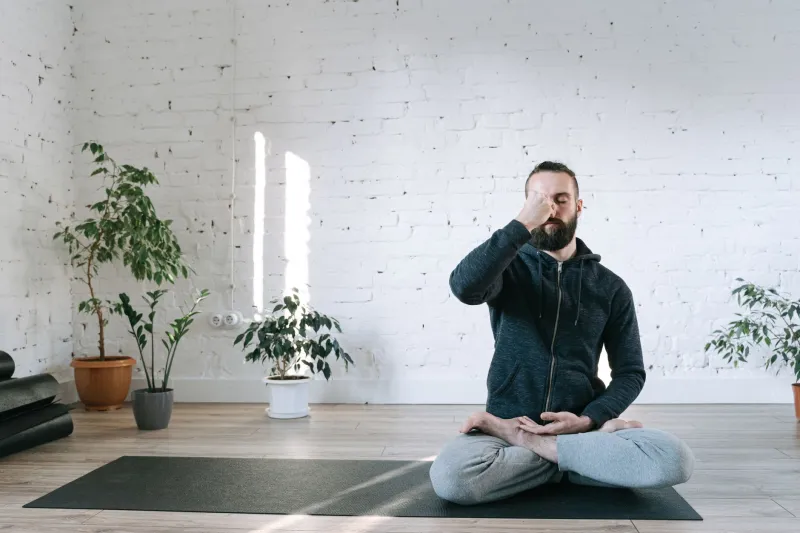
Why Coming Back to Reality After Meditation Can Feel Like a Crash Landing

You sat down, you breathed, you actually got somewhere quiet inside your own head. Maybe it took ten minutes, maybe twenty. But at some point, it happened — that soft, floaty sense of okayness that meditation can bring. And then your timer went off.
You opened your eyes. Someone was honking outside. Your phone had six notifications. The dishes were still in the sink.
And just like that, the calm was gone — not slowly, but like a door slamming shut.
If that sounds familiar, you're not doing anything wrong. What you're experiencing has a name, and it's more common than you think.
The 'Re-Entry' Phenomenon Nobody Talks About
Most meditation content focuses on getting into a meditative state. Very little attention gets paid to what happens when you come out of one — and that gap in the conversation leaves a lot of people confused, or even a little demoralized.
The jarring shift from deep stillness back to everyday life is sometimes called re-entry shock, and it's a real psychological and neurological event. It's not a sign that your meditation failed, or that you're too sensitive, or that mindfulness "doesn't work for you." It's actually a sign that something meaningful happened in your brain while you were sitting quietly.
Here's the basic science: during meditation, your nervous system shifts toward what researchers call a parasympathetic state — sometimes nicknamed "rest and digest." Your heart rate slows. Stress hormones like cortisol drop. Brain activity in the default mode network (the part responsible for rumination and self-referential chatter) quiets down. You're essentially stepping off a neurological treadmill.
When you re-enter ordinary life — with its noise, demands, screens, and unpredictability — your nervous system has to ramp back up, often quickly. That contrast can feel disorienting. Sometimes it even feels a little sad, like leaving somewhere you didn't want to leave.
Why Your Brain Treats Stillness Like a Different Room
Think of it this way: your brain is constantly calibrating to its environment. When you meditate regularly, your brain starts to associate that quiet, inward state with safety. Over time, the meditative space becomes something like a neurological home base — a place where threat responses are low and the nervous system can exhale.
Ordinary waking life, by contrast, is full of what neuroscientists call "low-grade stressors" — things that don't rise to the level of danger but keep your threat-detection system mildly activated. Traffic, deadlines, social media, the general unpredictability of being a person in the world. Your brain handles this constantly, usually without you noticing.
But when you've just spent time in a deeply regulated state, the contrast becomes noticeable. Walking back into ambient stress after genuine stillness can feel like stepping from a quiet library into a busy airport. The airport isn't necessarily bad. You're just suddenly aware of the noise in a way you weren't before.
Some practitioners describe this as heightened sensitivity — and in a sense, it is. Meditation can temporarily lower your perceptual threshold for stress, which means things that wouldn't have bothered you before your session might feel sharper afterward. This is temporary, and it's not a flaw in the practice. But it's useful to understand.
The Emotional Undercurrent
There's also a psychological layer here that's worth naming. For a lot of people — especially those dealing with anxiety, burnout, or chronic stress — meditation offers something that daily life doesn't always provide: a genuine sense of safety. No one needs anything from you in those minutes. There's no performance, no output, no judgment.
Returning to a world that does ask things of you can carry a subtle emotional weight, even when nothing overtly stressful is happening. It's not dramatic. It's more like the low hum of re-shouldering something you briefly put down.
Recognizing that feeling — without judgment — is actually part of the practice.
Practical Ways to Soften the Landing
The good news is that re-entry shock isn't something you have to just endure. There are real strategies that can help bridge the gap between your inner stillness and outer life.
Give yourself a transition buffer. Don't end your meditation and immediately grab your phone or jump up to make coffee. Even two or three minutes of just sitting quietly, eyes open, letting the room come back to you gradually, can make a noticeable difference. Think of it like slowly waking up rather than being jolted awake by an alarm.
Use a closing ritual. Some meditators find it helpful to end each session with the same small action — a few slow breaths, a gentle hand on the heart, a quiet word of intention. This creates a psychological bridge between the meditative state and what comes next, rather than a hard cut.
Carry one sensory anchor with you. Choose something simple — the feeling of your feet on the floor, the weight of your hands in your lap, the rhythm of your breath — and return to it periodically throughout your day. This isn't a full meditation; it's a thirty-second check-in that keeps a thread of that inner quiet alive even when life gets loud.
Reframe the transition itself. Instead of treating re-entry as the end of your practice, consider it an extension of it. The real test of meditation isn't how peaceful you feel on the cushion — it's how you respond to the first thing that goes sideways afterward. That moment of friction is where the practice actually lives.
Be honest about what you're returning to. Sometimes the crash landing feeling is data. If returning to your daily life consistently feels destabilizing, it might be worth asking what in that life is generating so much resistance. Meditation can be a tool for coping — but it can also be a mirror.
The Gap Is the Practice
There's a teaching in many contemplative traditions that the real work of meditation doesn't happen during the session — it happens in the space between sessions. The moment you open your eyes and step back into your life is exactly where everything you practiced gets applied.
That jarring feeling when the calm dissolves? It's an invitation. An invitation to notice, to breathe, to stay just a little softer than you might otherwise be.
You don't have to maintain perfect peace. You don't have to carry the meditation experience intact through your whole afternoon. You just have to keep returning — to your breath, to your body, to that small, quiet place inside you that knows how to settle.
It'll be there next time you sit down. And maybe, with a little practice, it'll be a little easier to find even when you're standing up.