Why Trying to Meditate 'Right' Is Making Your Anxiety Worse
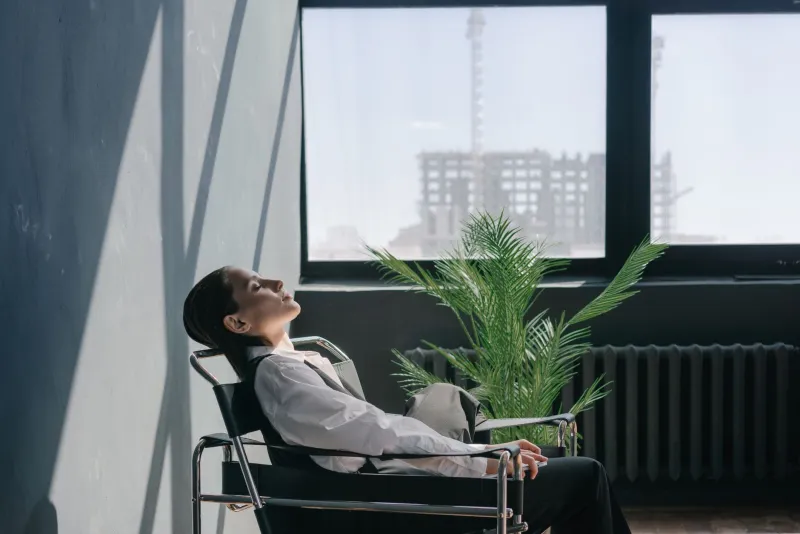
Let's be honest about something that doesn't get said enough in wellness spaces: for a lot of people living with anxiety, meditation doesn't feel like a relief. It feels like a test they keep failing.
You sit down. You close your eyes. Your brain immediately starts listing every email you haven't answered, every awkward thing you said in 2019, and whether that mole on your arm looks different than it did last week. You try to push those thoughts away. They come back louder. You get frustrated. You quit.
And then — because anxiety is nothing if not thorough — you spend the rest of the day feeling bad about quitting.
If that sounds familiar, you're not broken. You're not bad at meditation. You're just caught in a trap that almost every high-anxiety person falls into, and it has a name: the control paradox.
The Harder You Grip, the Worse It Gets
Here's what's actually happening in your brain when you try to "clear your mind" during meditation.
The prefrontal cortex — the part of your brain responsible for planning, decision-making, and yes, trying really hard to do things correctly — kicks into overdrive. It starts monitoring your thoughts. Flagging the bad ones. Attempting to redirect your attention with the subtlety of a hall monitor.
The problem? That monitoring process is itself a form of mental effort. And mental effort, when you're already anxious, signals to your nervous system that something requires vigilance. Which triggers more anxiety. Which produces more thoughts. Which requires more monitoring.
You've essentially set up a feedback loop where the act of trying to calm down is the thing keeping you wound up.
Psychologists sometimes call this "ironic process theory" — the idea that deliberately trying to suppress a thought actually increases how often it pops up. The classic example: try not to think about a white bear. You can't do it. The instruction creates the thought.
Anxious meditators do this constantly, just with higher stakes thoughts than polar bears.
The Permission Shift Nobody Told You About
So what actually works?
The short answer: stop trying to fix your mind and start getting curious about it instead.
This isn't just a vibe shift. There's real neuroscience behind it. Research on acceptance-based approaches — like Acceptance and Commitment Therapy (ACT) and Mindfulness-Based Stress Reduction (MBSR) — consistently shows that allowing uncomfortable thoughts to exist, rather than fighting them, reduces their emotional intensity over time.
When you stop treating your anxious thoughts as problems to be solved during meditation, something strange happens. They lose some of their grip. Not immediately, not completely — but enough.
The practice that tends to work best for high-anxiety individuals isn't "clear your mind." It's closer to: notice what's here, and let it be here for now.
That's it. That's the whole instruction.
You're not trying to achieve stillness. You're not trying to feel peaceful. You're just practicing the skill of observing your mental weather without becoming the storm.
What This Looks Like in Real Life
Say you sit down to meditate and within thirty seconds your brain serves up a worry about money. Under the old model, you'd try to push it away, feel guilty when it comes back, and spiral.
Under the permission-based model, you'd notice it — maybe even silently name it, like there's the money worry — and then gently return your attention to your breath. Not because the worry is gone. Not because it doesn't matter. But because right now, in this moment, you're choosing to observe rather than engage.
You're not suppressing the thought. You're not indulging it. You're just... letting it be a thought, rather than an emergency.
This is harder than it sounds, especially at first. Anxiety has a way of making thoughts feel urgent, like if you don't address them right now, something terrible will happen. That urgency is a feeling, not a fact. And meditation — the non-controlling, permission-based kind — is one of the few practices that actually trains you to tell the difference.
Why Anxious People Need a Different Starting Point
Most generic meditation advice was not written with anxiety in mind. It assumes a baseline level of nervous system regulation that a lot of Americans — particularly those dealing with chronic stress, trauma histories, or anxiety disorders — simply don't have when they start.
Telling someone with anxiety to "just relax and breathe" is a little like telling someone with a broken leg to "just walk it off." The instruction isn't wrong exactly, but it skips several important steps.
If you're in that camp, here's a gentler entry point:
Start with grounding, not stillness. Before you even try to meditate, spend two minutes just noticing five things you can physically feel — the weight of your body in the chair, the temperature of the air, the texture of your clothing. This isn't meditation yet. It's just anchoring your nervous system to the present moment.
Give yourself explicit permission to think. Before you begin, literally say to yourself: thoughts are allowed here. It sounds almost too simple, but removing the rule that thoughts are bad takes away a huge source of in-session anxiety.
Drop the timer pressure. If sitting for ten minutes feels like torture, sit for three. A three-minute session where you practice non-resistance is infinitely more useful than a ten-minute session spent white-knuckling your way through thought suppression.
Notice without narrating. When a thought shows up, try not to editorialize it. Not there's that stupid worry again but just there's a thought. The less judgment you attach, the less emotional charge it carries.
The Counterintuitive Truth About Control
Anxiety, at its core, is often about control — the desperate, exhausting need to manage outcomes, prevent bad things, and stay one step ahead of whatever might go wrong.
Meditation, done the way most anxious people attempt it, just becomes another control project. Another thing to optimize, perfect, and stress about.
But when you release that grip — when you genuinely stop trying to have the "right" meditation experience — something shifts. Not just in your practice, but in how you relate to your anxiety in general.
You start to realize that you can be in the presence of a difficult thought without being destroyed by it. That discomfort is survivable. That your mind, left to its own devices without constant intervention, actually settles on its own eventually.
That's not a small thing. That's the whole game.
You don't have to be good at meditation. You don't have to feel calm when you're done. You just have to keep showing up, keep letting things be a little more than you're used to, and trust that the practice is working even when — especially when — it doesn't feel like it is.